

Get Real Professional-Cloud-Network-Engineer Quesions Pass Google Certification Exams Easily
Professional-Cloud-Network-Engineer Dumps are Available for Instant Access
One of the key benefits of earning the Google Professional-Cloud-Network-Engineer certification is that it demonstrates a high level of expertise in Google Cloud Platform networking technologies, which can help IT professionals advance their careers. Google Cloud Certified - Professional Cloud Network Engineer certification can also help organizations identify skilled and knowledgeable professionals who can effectively design, implement, and manage network solutions on the Google Cloud Platform.
The Google Cloud Certified - Professional Cloud Network Engineer certification exam is structured to test the candidate's ability to design and configure Google Cloud networks, ensure high availability, and implement security measures to protect against threats. Professional-Cloud-Network-Engineer exam also evaluates the candidate's ability to troubleshoot issues related to network connectivity and performance. Professionals who pass Professional-Cloud-Network-Engineer exam demonstrate their competency in using Google Cloud networking technologies to create and manage secure and scalable networks.
NEW QUESTION # 126
You need to create the technical architecture for hybrid connectivity from your data center to Google Cloud This will be managed by a partner. You want to follow Google-recommended practices for production-level applications. What should you do?
- A. Ask the partner to install two security appliances in the data center. Configure one VPN connection from each of these devices to Google Cloud, and ensure that the VPN devices on-premises are in separate racks on separate power and cooling systems.
- B. Configure two Partner Interconnect connections in one metro and two connections in another metro Make sure the Interconnect connections are placed in different metro edge availability domains. Configure two VLAN attachments in one region and two VLAN attachments in another region, and configure global dynamic routing on the VPC
- C. Configure two Partner Interconnect connections in one metropolitan area (metro). Make sure the Interconnect connections are placed in different metro edge availability domains. Configure two VLAN attachments in a single region, and configure regional dynamic routing on the VPC
- D. Configure two Partner Interconnect connections in one metro and two connections in another metro. Make sure the Interconnect connections are placed in different metro edge availability domains. Configure two VLAN attachments in one region and two VLAN attachments in another region, and configure regional dynamic routing on the VPC.
Answer: D
Explanation:
"Google's recommended practices for production-level applications" and then see overview of these 2 pages- https://cloud.google.com/network-connectivity/docs/interconnect/tutorials/production-level-overview and https://cloud.google.com/network-connectivity/docs/interconnect/tutorials/non-critical-overview .
NEW QUESTION # 127
You have the following Shared VPC design VPC Flow Logs is configured for Subnet-1 In the host VPC. You also want to monitor flow logs for Subnet-2. What should you do?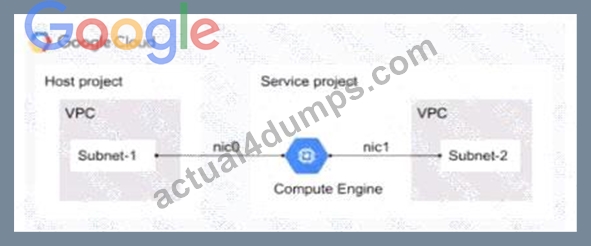
- A. Configure Packet Mirroring in both the host and service project VPCs.
- B. Configure a firewall rule to permit Subnet-2 IP addresses outbound in the host protect VPC.
- C. Configure a VPC Flow Logs filter for Subnet-2 in the host project VPC.
- D. Configure VPC Flow Logs in the service project VPC for Subnet-2.
Answer: D
Explanation:
* Understanding VPC Flow Logs:
* VPC Flow Logs is a feature that captures information about the IP traffic going to and from network interfaces in a VPC. It helps in monitoring and analyzing network traffic, ensuring security, and optimizing network performance.
* Current Configuration:
* According to the diagram, VPC Flow Logs is already configured for Subnet-1 in the host VPC.
This means that traffic information for Subnet-1 is being captured and logged.
* Requirement for Subnet-2:
* The goal is to monitor flow logs for Subnet-2, which is in the service project VPC.
* Correct Configuration for Subnet-2:
* To monitor the flow logs for Subnet-2, you need to configure VPC Flow Logs within the service project VPC where Subnet-2 resides. This is because VPC Flow Logs must be configured in the same project and VPC where the subnet is located.
* Implementation Steps:
* Go to the Google Cloud Console.
* Navigate to the service project where Subnet-2 is located.
* Select the VPC network containing Subnet-2.
* Enable VPC Flow Logs for Subnet-2 by editing the subnet settings and enabling the flow logs option.
* Cost and Performance Considerations:
* Enabling VPC Flow Logs may incur additional costs based on the volume of data logged. Ensure to review and understand the pricing implications.
* Analyze and manage the data collected to avoid unnecessary logging and costs.
:
Google Cloud VPC Flow Logs Documentation
Configuring VPC Flow Logs
Shared VPC Overview
By configuring VPC Flow Logs in the service project VPC for Subnet-2, you ensure that traffic data is correctly captured and monitored, adhering to Google Cloud's best practices.
NEW QUESTION # 128
You recently deployed two network virtual appliances in us-central1. Your network appliances provide connectivity to your on-premises network, 10.0.0.0/8. You need to configure the routing for your Virtual Private Cloud (VPC). Your design must meet the following requirements:
All access to your on-premises network must go through the network virtual appliances.
Allow on-premises access in the event of a single network virtual appliance failure.
Both network virtual appliances must be used simultaneously.
Which method should you use to accomplish this?
- A. Configure an internal TCP/UDP load balancer with the two network virtual appliances as backends. Configure a route for 10.0.0.0/8 with the internal load balancer as the next hop.
- B. Configure two routes for 10.0.0.0/8 with different priorities, each pointing to separate network virtual appliances.
- C. Configure a network load balancer for the two network virtual appliances. Configure a route for 10.0.0.0/8 with the network load balancer as the next hop.
- D. Configure an internal HTTP(S) load balancer with the two network virtual appliances as backends. Configure a route for 10.0.0.0/8 with the internal HTTP(S) load balancer as the next hop.
Answer: D
NEW QUESTION # 129
You are increasing your usage of Cloud VPN between on-premises and GCP, and you want to support more traffic than a single tunnel can handle. You want to increase the available bandwidth using Cloud VPN.
What should you do?
- A. Add a second on-premises VPN gateway with a different public IP address. Create a second tunnel on the existing Cloud VPN gateway that forwards the same IP range, but points at the new on-premises gateway IP.
- B. Double the MTU on your on-premises VPN gateway from 1460 bytes to 2920 bytes.
- C. Add a second Cloud VPN gateway in a different region than the existing VPN gateway. Create a new tunnel on the second Cloud VPN gateway that forwards the same IP range, but points to the existing on-premises VPN gateway IP address.
- D. Create two VPN tunnels on the same Cloud VPN gateway that point to the same destination VPN gateway IP address.
Answer: A
Explanation:
https://cloud.google.com/network-connectivity/docs/vpn/concepts/classic-topologies#redundancy-options
NEW QUESTION # 130
You have the networking configuration shown In the diagram Two VLAN attachments associated With two Dedicated Interconnect connections terminate on the same Cloud Router (mycloudrouter). The Interconnect connections terminate on two separate on-premises routers. You advertise the same prefixes from the Border Gateway Protocol (BOP) sessions associated With each Of the VLAN attachments.
You notice an asymmetric traffic flow between the two Interconnect connections. Which of the following actions should you take to troubleshoot the asymmetric traffic flow?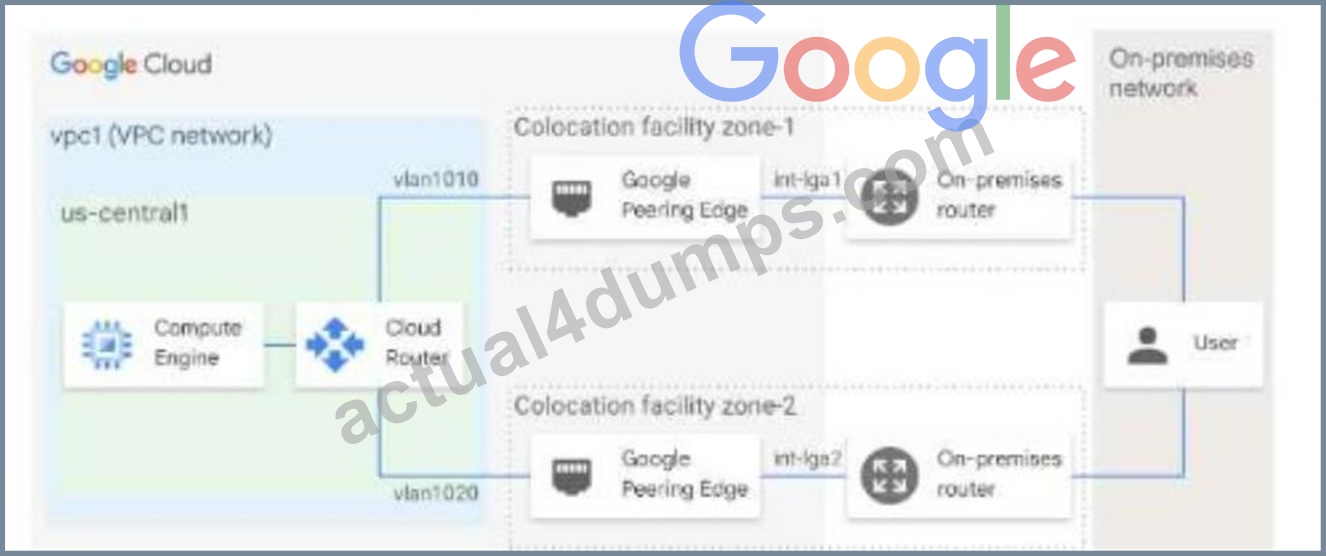
- A. From the Google Cloud console, navigate to Cloud Logging to view VPC Flow Logs and review the results
- B. From the Google Cloud console, navigate to the Hybrid Connectivity select the Cloud Router, and view BGP sessions.
- C. From the Cloud CLI. run gcloud compute routers describe mycloudrouter
- D. From the Cloud CLI, run gcloud compute -protect_ID router get-status mycloudrouter --region REGION and review the results.
Answer: D
Explanation:
--region REGION and review the results
Explanation:
The correct answer is B. From the Cloud CLI, run gcloud compute --project_ID router get-status mycloudrouter --region REGION and review the results.
This command will show you the BGP session status, the advertised and learned routes, and the last error for each VLAN attachment. You can use this information to troubleshoot the asymmetric traffic flow and identify any issues with the BGP configuration or the Interconnect connections.
The other options are not correct because:
Option A will only show you the BGP session status, but not the advertised and learned routes or the last error for each VLAN attachment.
Option C will only show you the VPC Flow Logs, which are useful for monitoring and troubleshooting network performance and security issues within your VPC network, but not for your Interconnect connections.
Option D will only show you the basic information about the Cloud Router, such as its name, region, network, and BGP settings, but not the detailed status of each VLAN attachment.
NEW QUESTION # 131
Your software team is developing an on-premises web application that requires direct connectivity to Compute Engine Instances in GCP using the RFC 1918 address space. You want to choose a connectivity solution from your on-premises environment to GCP, given these specifications:
Your ISP is a Google Partner Interconnect provider.
Your on-premises VPN device's internet uplink and downlink speeds are 10 Gbps.
A test VPN connection between your on-premises gateway and GCP is performing at a maximum speed of 500 Mbps due to packet losses.
Most of the data transfer will be from GCP to the on-premises environment.
The application can burst up to 1.5 Gbps during peak transfers over the Interconnect.
Cost and the complexity of the solution should be minimal.
How should you provision the connectivity solution?
- A. Use network compression over your VPN to increase the amount of data you can send over your VPN.
- B. Create multiple VPN tunnels to account for the packet losses, and increase bandwidth using ECMP.
- C. Provision a Partner Interconnect through your ISP.
- D. Provision a Dedicated Interconnect instead of a VPN.
Answer: C
Explanation:
Direct Interconnect will be too expensive and also an overkill for this requirement. Managing multiple tunnels that too with packet loss consideration is complex also. Whereas partner interconnect fits the bill with providing required bandwidth but not super expensive also once setup not too complex too manage.
NEW QUESTION # 132
You need to give each member of your network operations team least-privilege access to create, modify, and delete Cloud Interconnect VLAN attachments.
What should you do?
- A. Assign each user the editor role.
- B. Give each user the following permissions only: compute.interconnectAttachments.create, compute.
interconnectAttachments.get, compute.routers.create, compute.routers.get, compute.routers.update. - C. Assign each user the compute.networkAdmin role.
- D. Give each user the following permissions only: compute.interconnectAttachments.create, compute.
interconnectAttachments.get.
Answer: B
Explanation:
https://cloud.google.com/interconnect/docs/how-to/dedicated/creating-vlan-attachments
NEW QUESTION # 133
(You are managing an application deployed on Cloud Run. The development team has released a new version of the application. You want to deploy and redirect traffic to this new version of the application. To ensure traffic to the new version of the application is served with no startup time, you want to ensure that there are two idle instances available for incoming traffic before adjusting the traffic flow. You also want to minimize administrative overhead. What should you do?)
- A. Configure revision autoscaling for the new revision and set the minimum number of instances to 2.
- B. Configure service autoscaling and set the minimum number of instances to 2.
- C. Configure revision autoscaling for the existing revision and set the minimum number of instances to 2.
- D. Ensure the checkbox "Serve this revision immediately" is unchecked when deploying the new revision.
Before changing the traffic rules, use a traffic simulation tool to send load to the new revision.
Answer: A,C,D
Explanation:
Let's analyze each option to find the one that meets the requirements of no startup time for new traffic, two idle instances, and minimal administrative overhead:
A: Unchecking "Serve this revision immediately" and using a traffic simulation tool: Unchecking "Serve this revision immediately" does prevent the new revision from receiving traffic immediately. However, manually using a traffic simulation tool adds administrative overhead. It also doesn't guarantee that two idle instances will be ready before traffic is shifted; you would need to monitor and adjust traffic manually based on the simulation.
B: Configuring service autoscaling and setting the minimum number of instances to 2: Service-level autoscaling applies to all revisions of the service. Setting the minimum instances at the service level would ensure at least two instances are running across all active revisions, not specifically for the new revision before traffic shift.
C: Configuring revision autoscaling for the new revision and setting the minimum number of instances to 2:
This is the correct approach. By configuring revision autoscaling specifically for the new revision and setting the minimum number of instances to 2, Cloud Run will ensure that at least two instances of the new version are running and ready to serve traffic before you redirect any traffic to it. This eliminates startup latency when you do shift traffic. It also minimizes administrative overhead as Cloud Run manages the instance scaling based on this configuration.
D: Configuring revision autoscaling for the existing revision and setting the minimum number of instances to
2: This would ensure the existing version has at least two idle instances, which doesn't directly address the requirement of having idle instances ready for the new version before traffic redirection.
Google Cloud Documentation References:
Cloud Run Autoscaling: https://cloud.google.com/run/docs/configuring/min-instances - This document explains how to configure minimum and maximum instances for Cloud Run services and revisions. It clarifies that you can set minimum instances at the revision level to ensure instances are always ready.
Cloud Run Traffic Management: https://cloud.google.com/run/docs/managing/traffic - This describes how to deploy new revisions and gradually shift traffic between them. Combining minimum instances on the new revision with traffic splitting allows for zero-downtime deployments with pre-warmed instances.
NEW QUESTION # 134
You have recently been put in charge of managing identity and access management for your organization. You have several projects and want to use scripting and automation wherever possible. You want to grant the editor role to a project member.
Which two methods can you use to accomplish this? (Choose two.)
- A. setIamPolicy() via REST API
- B. GetIamPolicy() via REST API
- C. gcloud pubsub add-iam-policy-binding Sprojectname --member user:Susername -- role roles/editor
- D. gcloud projects add-iam-policy-binding Sprojectname --member user:Susername --role roles/editor
- E. Enter an email address in the Add members field, and select the desired role from the drop-down menu in the GCP Console.
Answer: D,E
Explanation:
https://cloud.google.com/iam/docs/granting-changing-revoking-access
NEW QUESTION # 135
You have the following firewall ruleset applied to all instances in your Virtual Private Cloud (VPC):
You need to update the firewall rule to add the following rule to the ruleset:
You are using a new user account. You must assign the appropriate identity and Access Management (IAM) user roles to this new user account before updating the firewall rule. The new user account must be able to apply the update and view firewall logs. What should you do?
- A. Assign the compute.securityAdmin and logging.bucketWriter role to the new user account. Apply the new firewall rule with a priority of 150.
- B. Assign the compute.securityAdmin and logging.viewer rule to the new user account. Apply the new firewall rule with a priority of 50.
- C. Assign the compute.orgSecurityPolicyAdmin and logging.bucketWriter role to the new user account. Apply the new firewall rule with a priority of 150.
- D. Assign the compute.orgSecurityPolicyAdmin and logging.viewer role to the new user account. Apply the new firewall rule with a priority of 50.
Answer: B
NEW QUESTION # 136
In order to provide subnet level isolation, you want to force instance-A in one subnet to route through a security appliance, called instance-B, in another subnet.
What should you do?
- A. Create a more specific route than the system-generated subnet route, pointing the next hop to instance-B with a tag applied to instance-A.
- B. Delete the system-generated subnet route and create a specific route to instance-B with a tag applied to instance-A.
- C. Create a more specific route than the system-generated subnet route, pointing the next hop to instance-B with no tag.
- D. Move instance-B to another VPC and, using multi-NIC, connect instance-B's interface to instance-A's network. Configure the appropriate routes to force traffic through to instance-A.
Answer: A
NEW QUESTION # 137
You are deploying a global external TCP load balancing solution and want to preserve the source IP address of the original layer 3 payload.
Which type of load balancer should you use?
- A. Internal load balancer
- B. Network load balancer
- C. HTTP(S) load balancer
- D. TCP/SSL proxy load balancer
Answer: D
Explanation:
By default TCP/SSL proxy load balancer original client IP address and port information is not preserved, but it can be preserved using the PROXY protocol: https://cloud.google.com/load-balancing/docs/tcp#target-proxies
https://medium.com/google-cloud/preserving-client-ips-through-google-clouds-global-tcp-and-ssl-proxy-load-balancers-3697d76feeb1
NEW QUESTION # 138
You are deploying an HA VPN within Google Cloud. You need to exchange routes dynamically between your on-premises gateway and Google Cloud. You have already created an HA VPN gateway and a peer VPN gateway resource. What should you do?
- A. Create a second HA VPN gateway, add VPN tunnels, and enable global dynamic routing.
- B. Create a Cloud Router, add VPN tunnels, and then configure static routes to your subnet ranges.
- C. Create a Cloud Router, add VPN tunnels, and then configure BGP sessions.
- D. Create a Cloud Router, add VPN tunnels, and enable global dynamic routing.
Answer: C
Explanation:
Explanation: To dynamically exchange routes between Google Cloud and your on-premises gateway, you need to create a Cloud Router and configure BGP sessions after adding VPN tunnels. BGP allows for dynamic route exchange, which is essential for establishing proper communication between the environments.
NEW QUESTION # 139
Your company has provisioned 2000 virtual machines (VMs) in the private subnet of your Virtual Private Cloud (VPC) in the us-east1 region. You need to configure each VM to have a minimum of 128 TCP connections to a public repository so that users can download software updates and packages over the internet. You need to implement a Cloud NAT gateway so that the VMs are able to perform outbound NAT to the internet. You must ensure that all VMs can simultaneously connect to the public repository and download software updates and packages. Which two methods can you use to accomplish this? (Choose two.)
- A. Use the default Cloud NAT gateway to automatically scale to the required number of NAT IP addresses, and update the minimum number of ports per VM to 128.
- B. Configure the NAT gateway in manual allocation mode, allocate 4 NAT IP addresses, and update the minimum number of ports per VM to 128.
- C. Create a second Cloud NAT gateway with the default minimum number of ports configured per VM to
64. - D. Configure the NAT gateway in manual allocation mode, allocate 2 NAT IP addresses, and update the minimum number of ports per VM to 256.
- E. Use the default Cloud NAT gateway's NAT proxy to dynamically scale using a single NAT IP address.
Answer: C,D
NEW QUESTION # 140
You are deploying a global external TCP load balancing solution and want to preserve the source IP address of the original layer 3 payload.
Which type of load balancer should you use?
- A. Internal load balancer
- B. Network load balancer
- C. HTTP(S) load balancer
- D. TCP/SSL proxy load balancer
Answer: D
Explanation:
By default TCP/SSL proxy load balancer original client IP address and port information is not preserved, but it can be preserved using the PROXY protocol: https://cloud.google.com/load-balancing/docs/tcp#target- proxies
https://medium.com/google-cloud/preserving-client-ips-through-google-clouds-global-tcp-and-ssl-proxy-load- balancers-3697d76feeb1 Reference: https://cloud.google.com/load-balancing/docs/network
NEW QUESTION # 141
You are the network administrator responsible for hybrid connectivity at your organization. Your developer team wants to use Cloud SQL in the us-west1 region in your Shared VPC. You configured a Dedicated Interconnect connection and a Cloud Router in us-west1, and the connectivity between your Shared VPC and on-premises data center is working as expected. You just created the private services access connection required for Cloud SQL using the reserved IP address range and default settings. However, your developers cannot access the Cloud SQL instance from on-premises. You want to resolve the issue. What should you do?
- A. Modify the VPC Network Peering connection used for Cloud SQL, and enable the import and export of routes.
Create a custom route advertisement in your Cloud Router to advertise the Cloud SQL IP address range. - B. Change the VPC routing mode to global.Modify the VPC Network Peering connection used for Cloud SQL, and enable the import and export of routes.
- C. Change the VPC routing mode to global.
Create a custom route advertisement in your Cloud Router to advertise the Cloud SQL IP address range. - D. Create an additional Cloud Router in us-west2.
Create a new Border Gateway Protocol (BGP) peering connection to your on-premises data center.
Modify the VPC Network Peering connection used for Cloud SQL, and enable the import and export of routes.
Answer: A
NEW QUESTION # 142
......
Get Instant Access REAL Professional-Cloud-Network-Engineer DUMP Pass Your Exam Easily: https://examsboost.actual4dumps.com/Professional-Cloud-Network-Engineer-study-material.html